
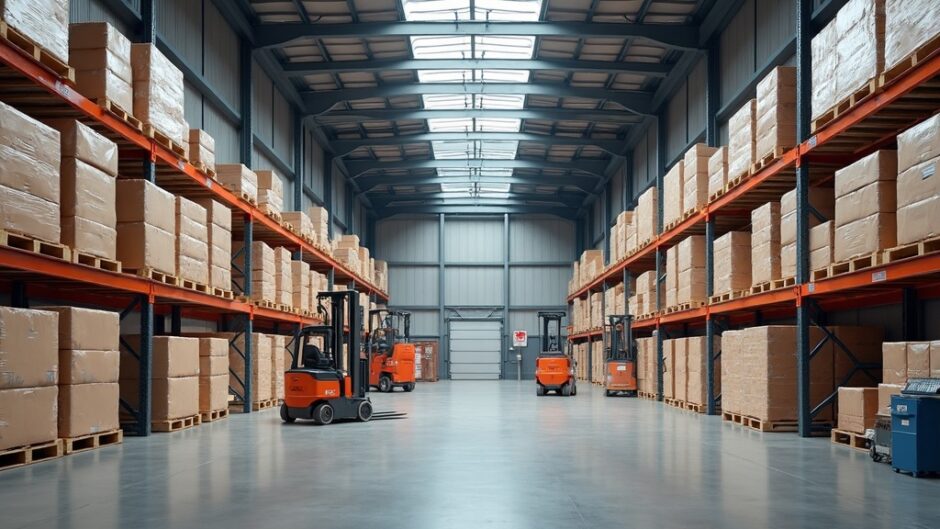
How to Align Your Warehouse Storage Strategy with Fast-Moving Inventory
Having a warehouse management system is of no use if your warehouse layout itself is creating obstacles. You need to ensure that the high-speed inventory in your warehouse is not just stored efficiently but also located suitably, your racking is facilitating the quick movement of your goods, and the right load carriers are deployed to eliminate downtimes at the most inopportune times.
Run ABC Analysis On A Rolling Basis
Many warehouse managers conduct an ABC classification, slot their products, and then do not revisit the classification. However, product demand fluctuates. A product that was classified as an "A" may become a "C" a few months later. If it is still slotted as an "A", then the system is not working efficiently.
ABC analysis classifies products according to their turnover and their value: "A" products have high turnover and value while "C" products have low turnover and value.
Just conducting the analysis once is not sufficient; the system needs to be dynamic and should be continuously updated every month for top moving products, for instance. When products change in grade (e.g., when a "C" becomes an "A"), they need to be reslotted as they are the ones that are picked most frequently.
Match Racking Type To Velocity, Not Just Volume
Deep-lane and double-deep racking configurations may be optimal solutions in terms of space, but they are suboptimal solutions if you have a fast-moving inventory. When you’re constantly going in and out of a pallet position, and repeatedly reaching to the back for the next load, you might as well be paying a team of people to run 20 yards back and forth all day in a retail warehouse.
A selective pallet racking system gives you access to every pallet position. Gravity flow racks give you that same benefit, but also allow the pallet to roll forward as it’s removed. This lets the next pallet feed forward and the next and the next. In this way, the first-in, first-out access is kept intact while returning your team’s manual labor to higher value tasks. The ability to pick from the front while replenishing from the rear can be a much-needed engineering approach to solving a real operational bottleneck.
Standardize Your Load Carriers Before Anything Else
This is an aspect that is often overlooked when discussing warehouse storage. A WMS can plan the perfect pick sequence. Your racking can be perfectly configured. None of it makes a difference if a damaged pallet causes a forklift to stall mid-aisle, drops a load, or jams a conveyor system.
Operations that move quickly are high-repetition environments. The same pallets are constantly moving, and poor or damaged pallets are opportunity after opportunity to experience a delay. Sourcing consistent, properly-dimensioned load carriers from a supplier which provides Pallet Products in Melbourne keeps racking systems running cleanly and reduces risk of failure.
Uniform dimensions are also vital for automated handling. Conveyors and sortation systems work to very exact specifications, quickly becoming jammed or creating a danger for operators when off-size pallets are introduced into the system.
Reduce Travel Time Through Deliberate Layout Design
Travel time may amount to half of the total picking hours (Warehousing Education and Research Council). That is the single largest cost factor in most picking operations, so slotting, and aisle design are essentially labor-cost decisions, not purely logistics options.
High-velocity zones must be located as close to dispatch as possible within the constraints of the building. Aisles in these zones must be wide enough for two-way movement without congestion or deliberately designed as one-way flows to remove the bottleneck of opposing traffic. Pickers must not be forced to travel through slow-moving inventory areas in order to access a fast-moving pick zone.
The layout needs to be built around how the building is actually used at peak throughput, not around what looks organized on a floor plan.
Use Cross-Docking For Your Fastest-Turning SKUs
For products that have very high turnover – products that are in the warehouse possibly today and on a truck tomorrow – the entire notion of storage is dead wrong. Cross-docking routes incoming goods directly to the outbound staging area, bypassing put-away and retrieval altogether.
This strategy takes reliable inbound scheduling, clean staging lanes, and lift trucks that can cross the dock safely and seamlessly for optimal results. As the time energy put in to handling products two or three times is removed from the process, those fast movers can keep moving without ever spending time in a rack position.
Not every SKU is going to apply here, but the ones that do will see the largest increase in throughput from elimination of the storage cycle.
The physical variables – racking configuration, pallet quality, slotting position, aisle design – are what determine how fast your warehouse can actually operate. Software helps you see the problem. The floor is where you solve it.